info@cngoldensea.com
+(86)15122654356
Common connection methods and characteristics of butterfly valves
Butterfly valves are classified into various connection methods based on installation requirements. Here are the most common ones in the industrial field:
1. Wafer type connection
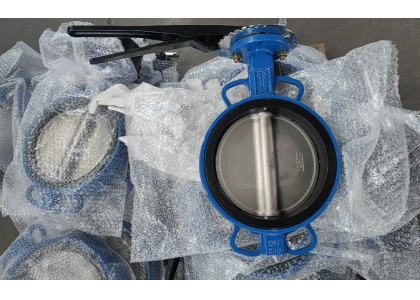
Structure: The valve body has no flange and is directly clamped between the pipe flanges by bolts.
Advantages: Small size, light weight, low cost, suitable for scenarios with limited space.
Disadvantages: Requires a matching flange, and the entire pipeline needs to be disconnected during disassembly.
2. Flange type connection
Structure: The valve body has its own flange, and it is fixed to the pipe flange by bolts.
Advantages: Good sealing performance, easy for separate disassembly and maintenance, suitable for medium and high-pressure pipelines.
Disadvantages: Larger volume and weight, higher cost.
3. Threaded type connection
Structure: The valve body is processed with internal or external threads, and it is directly screwed into the pipe.
Advantages: Installation is simple, often used for small diameters (DN15-DN50) and low pressure (≤1.6MPa) systems.
Disadvantages: Poor sealing performance, prone to leakage in high-temperature and high-pressure scenarios.
4. Welding type connection
Structure: The valve body is directly connected to the pipeline through arc welding or argon arc welding (commonly used in carbon steel/stainless steel valves).
Advantages: Zero leakage, high pressure resistance (up to PN100 or above), suitable for high-temperature and high-pressure or long-term pipelines (such as oil and chemical pipelines).
Disadvantages: Not detachable, maintenance requires cutting the pipeline.
In-depth analysis of welding connection butterfly valves
Applicable materials: Carbon steel (WCB), stainless steel (CF8/CF8M) butterfly valves can all be welded, but cast iron valves generally do not support due to their brittleness.
Welding types:
Butt welding (BW): The valve body has a bevel, and it is welded to the pipe at the joint, suitable for large-diameter valves (DN50 and above).
Socket welding (SW): The valve body has a socket, and the pipe is inserted and then welded, mostly used for small-diameter valves (DN50 and below).
How to choose the appropriate connection method?
1. Consider pressure level: For low pressure (≤1.6MPa), threaded/socket type can be selected; for medium and high pressure (≥2.5MPa), priority should be given to flange or welding.
2. Maintenance requirements: Avoid welding in scenarios with frequent maintenance, choose flange or socket type.
3. Cost control: Socket type has the lowest cost, while welding type has a price that is usually 30%-50% higher due to the complex process.
Goldensea is one of the Global leading water valve suppliers and ductile iron butterfly valve manufacturers, which was established in the year 1991. The main products are butterfly valves...[ read more ]


