
info@cngoldensea.com
+(86)15122654356
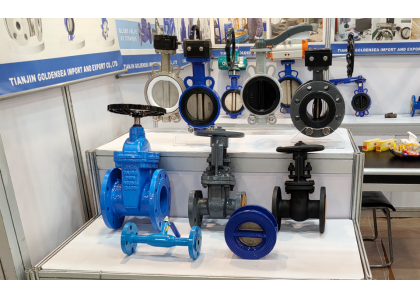
A butterfly valve is also known as a flap valve. It is a simple regulating valve with a structure that is easy to operate. A butterfly valve used for controlling the opening and closing of a medium in a low-pressure pipeline refers to a valve where the closing element (valve disc or butterfly plate) is a round disc that rotates around the valve axis to achieve opening and closing. Valves can be used to control the flow of various types of fluids such as air, water, steam, various corrosive media, mud, oil, liquid metal, and radioactive media. They mainly play a role in cutting off and throttling in pipelines. The opening and closing element of a butterfly valve is a disc-shaped butterfly plate, which rotates within the valve body around its own axis to achieve the purpose of opening or closing or regulation.
Types of butterfly valves
1. According to different connection forms, they can be divided into wafer-type butterfly valves, flange-type butterfly valves, welded butterfly valves, threaded butterfly valves, and clamp-type butterfly valves, etc. The most commonly used connection forms are wafer type butterfly valves and flange-type butterfly valves.
2. According to different transmission methods, they can be divided into handle butterfly valves, turbine butterfly valves, pneumatic butterfly valves, electric butterfly valves, hydraulic butterfly valves, and electromagnetic valves. The most common transmission methods are handle, turbine, pneumatic, and electric. Handle butterfly valves and turbine butterfly valves are collectively called manual butterfly valves.
3. According to different sealing surface materials, they can be divided into soft-sealing butterfly valves and metal-sealing butterfly valves. Soft-sealing butterfly valves have better sealing performance than metal-sealing butterfly valves. The commonly used materials for the sealing surface of soft-sealing butterfly valves include EPDM, nitrile rubber, and PTFE. Metal-sealing butterfly valves are mainly used in high-temperature and high-pressure working conditions.
4. According to different structural forms, they can be divided into wafer butterfly valves, single eccentric butterfly valves, double eccentric butterfly valves, and triple eccentric butterfly valves. Among them, wafer butterfly valves usually use soft seals; eccentric butterfly valves use hard seals. Triple eccentric butterfly valves have the excellent sealing performance of soft-sealing butterfly valves and the characteristics of high-temperature, high-pressure, and corrosion resistance of hard-sealing butterfly valves.
5. According to different working pressures, they can be divided into vacuum butterfly valves (with a nominal pressure lower than the standard atmospheric pressure), low-pressure butterfly valves (with a nominal pressure PN < 1.6 MPa), medium-pressure butterfly valves (with a nominal pressure PN 2.5 - 6.4 MPa), high-pressure butterfly valves (with a nominal pressure PN 10.0 - 80.0 MPa), and ultra-high-pressure butterfly valves (with a nominal pressure PN > 100 MPa).
A gate valve is also known as a gate valve. Inside the valve body, there is a gate plate perpendicular to the direction of the material flow. When the gate plate rises, the gate valve opens, and when it lowers, it closes. A gate valve consists of components such as the main shaft, valve stem nut, cover, valve stem, valve body, gate plate, and flange surface.
Gate valves can be classified as exposed shaft and concealed shaft types. Exposed shaft gate valves are usually used for corrosive substances and indoor areas; concealed shaft gate valves are used for non-corrosive substances and areas where the operation position is restricted. According to the different structural forms of the gate plate, they can be divided into wedge type and parallel type. The wedge type is mostly made with a single gate plate, with the flange surfaces forming a wedge shape. The parallel type is mostly made with double gate plates, with the flange surfaces being parallel. The parallel type is easier to manufacture and maintain than the wedge type, but it cannot transport liquids with impurities and can only transport clean liquids. Gate valves are often used as disconnection valves for materials, oil, and gas, and are not suitable for controlling the total flow. Because when the gate valve is partially open, the gate plate that has not been raised can be damaged by the material over time, and the surface will not be tight and leak, so gate valves should be fully closed or fully open. The characteristics of gate valves are good sealing performance, small resistance to material flow when fully opened, and a shorter valve body. The disadvantage is that the structure is more complex, the flange surface is prone to damage, and maintenance is more difficult. Gate valves are often used in discharge valves of containers, inlet valves of centrifugal pumps, pipelines with bidirectional material flow, pipelines requiring low transportation resistance, and places where the length of valve body installation is restricted.
Goldensea is one of the Global leading water valve suppliers and ductile iron butterfly valve manufacturers, which was established in the year 1991. The main products are butterfly valves...[ read more ]


