
info@cngoldensea.com
+(86)15122654356
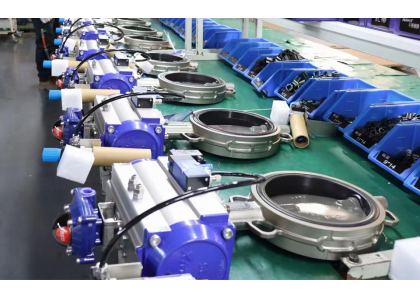
Pneumatic butterfly valves are widely used in industrial fluid control systems and are mainly used for regulating and cutting off the flow of fluids. Depending on the driving method, pneumatic butterfly valves can be divided into single-acting and double-acting types.
Firstly, a single-acting pneumatic butterfly valve refers to a valve that only requires the air source provided by the pneumatic device during operation. This type of valve is generally equipped with a spring mechanism, and the valve disc is opened by air pressure, while when the air source is disconnected, the spring will automatically reset the valve disc to its initial position. The advantage of a single-acting valve lies in its simple structure, easy installation, and the ability to quickly close the valve when the air source is disconnected, preventing fluid leakage and suitable for applications with high safety requirements. For example, in water treatment, chemical industries, etc., single-acting pneumatic butterfly valves are often used for emergency shut-off or safety protection.
In a single-acting pneumatic butterfly valve, the selection of the spring is crucial as it directly affects the response speed and closing force of the valve. To ensure that the valve can reliably close when the air source fails, the specifications of the spring need to be designed reasonably according to the properties of the fluid and the working pressure.
On the other hand, a double-acting pneumatic butterfly valve refers to a valve that requires the air source provided by the pneumatic device to complete the opening and closing of the valve during operation. Different from the single-acting valve, the operation of a double-acting valve relies on the alternating action of air pressure, that is, when opening, the valve disc is pushed to the open position by the air source, while when closing, the valve disc is pushed back to the closed position by the reverse air source. This design gives the double-acting pneumatic butterfly valve higher flexibility and control accuracy, and can adapt to more complex working conditions.
The advantage of a double-acting pneumatic butterfly valve is that its valve movement is more stable, achieving a faster response speed, so it is often a more ideal choice in applications that require frequent opening and closing or precise flow control. For example, in pharmaceuticals, food processing, and highly demanding chemical processes, double-acting pneumatic butterfly valves can meet strict operating requirements.
However, the disadvantage of a double-acting pneumatic butterfly valve is that the system is relatively complex, requiring more air source pipelines and control systems, and in the event of an air source failure, the valve cannot automatically reset, which may bring certain risks in some safety-critical application scenarios.
Goldensea is one of the Global leading water valve suppliers and ductile iron butterfly valve manufacturers, which was established in the year 1991. The main products are butterfly valves...[ read more ]


