
info@cngoldensea.com
+(86)15122654356
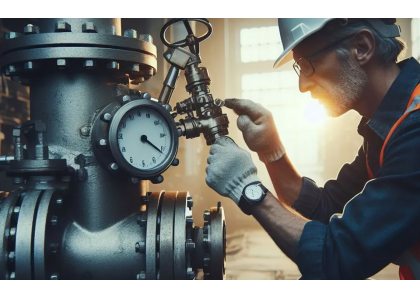
1. Visual Inspection
Clean the valve surface
Regularly clean the outer surface of the valve to remove dust, oil, rust and other impurities. Use a clean, soft cloth or brush for cleaning. For stubborn stains, appropriate cleaning agents can be used, but be careful to avoid corrosion of the valve material. For example, for stainless steel valves, mild alkaline cleaning agents can be used; for valves with painted surfaces, choose cleaning agents that do not damage the paint.
Clean the valve nameplate to ensure the information on it is clear and legible. The nameplate contains important information such as the valve model, specification, pressure rating, and production date, which are crucial for valve maintenance, repair, and replacement.
Check the integrity of the valve appearance
Carefully inspect the valve body, valve cover, flange and other components for signs of cracks, deformation or damage. Cracks may cause medium leakage, while deformation may affect the normal operation and sealing performance of the valve. For cast iron valves, pay special attention to checking for casting defects such as sand holes that may cause leakage.
Check the connection parts of the valve, such as whether the bolts at the flange connection are loose, fallen off or corroded. Loose bolts will affect the sealing performance of the flange and should be tightened in time; corroded bolts may need to be replaced to ensure the reliability of the connection. At the same time, check whether the gasket at the connection part is intact. If it is damaged or aged, it should be replaced in time.
Observe whether the operation components of the valve, such as the handwheel, handle or electric actuator, are damaged, deformed or missing. These components are key to controlling the opening and closing of the valve. If they are damaged, the valve may not operate normally. For example, damage to the handwheel may prevent the operator from accurately controlling the valve opening.
2. Valve Sealing Performance Check
External Leakage Check
For the valve stem sealing area, check for medium leakage. A small amount of leak detection fluid can be applied around the valve stem to observe if there are any bubbles. If there are bubbles, it indicates that there is a leakage in the valve stem seal, and further inspection of the packing or seal is required. If necessary, replace the packing or seal to solve the leakage problem.
Check for leakage at the flange connection of the valve. Similarly, use leak detection fluid to observe if there are any bubbles at the flange edge. For flanges with minor leakage, it may be necessary to retighten the bolts or replace the gasket to repair the leakage. For severe leakage, first close the upstream and downstream valves, empty the medium in the pipeline, and then carry out maintenance.
Internal Leakage Check
Depending on the type of valve and the working medium, different methods can be used to check for internal leakage. For stop valves and gate valves, close the valve and observe if there is any medium flow downstream to determine the internal leakage situation.
For ball valves and butterfly valves, the internal leakage situation can be preliminarily judged by checking if the position indicator accurately indicates the closed position after the valve is closed. If the position indicator shows that the valve is fully closed but there is still medium leakage, it may be a problem with the seal between the ball or disc and the valve seat. Further inspection of the sealing surface of the valve seat for wear, scratches or impurities is required. If necessary, grinding or replacement of the valve seat should be carried out.
3. Valve Operating Performance Check
Manual Valve Operation Check
Regularly operate manual valves to check if the opening and closing are smooth. When opening and closing the valve, pay attention to whether the operating force is uniform and if there is any jamming or abnormal resistance. If the operation is difficult, it may be due to excessive friction between the valve stem and the packing, foreign objects stuck in the valve body, or damage to the valve components.
Check if the valve opening indication is accurate. For valves with opening indicators, such as control valves, observe if the reading of the opening indicator matches the actual opening during operation. Inaccurate opening indication may affect the flow control of the system, and the indicator needs to be calibrated or repaired. For manual valves that are frequently operated, it is necessary to pay attention to the wear of the handwheel or handle. Excessive wear of the operating parts may affect the operator's sense of touch and even lead to loss of control during operation. Worn handwheels or handles should be replaced in a timely manner to ensure the safety and accuracy of valve operation.
Electric valve operation inspection
Check whether the power connection of the electric valve is normal, and whether the wires are damaged, aged or loose. Ensure that the control signal transmission of the electric actuator is normal. This can be checked by operating the control system to see if the valve can accurately open, close or adjust the opening degree according to the instructions.
Observe the operation of the electric valve during operation, such as whether the opening and closing speed of the valve meets the requirements, and whether there is abnormal vibration or noise. Abnormal vibration or noise may be caused by damage to the internal components of the electric actuator, mechanical structure failure of the valve, or improper installation. Further inspection and maintenance of the electric valve are required, including checking the working status of the motor, reducer, coupling, and other components.
Regularly inspect and adjust the travel limit switch of the electric valve. The travel limit switch is an important device for controlling the opening and closing positions of the valve. If the limit switch fails, it may cause the valve to be over-opened or over-closed, damaging the valve or the electric actuator. By simulating the full opening and full closing actions of the valve, check whether the limit switch can accurately cut off the power supply to the motor to ensure the safety of valve operation.
4. Inspection of valve accessories
Filter inspection
If a filter is installed upstream of the valve, it should be inspected regularly for blockage. A blocked filter will reduce fluid flow and increase pressure loss, affecting the normal operation of the valve. The blockage of the filter can be determined by observing the pressure difference between the two ends of the filter. When the pressure difference exceeds a certain limit, the filter needs to be cleaned or the filter element replaced.
When cleaning the filter, follow the correct operating procedures to avoid damaging the filter screen or other components. For some precision filters, special cleaning equipment and cleaning agents may be required. After cleaning, ensure that the filter is installed correctly and sealed properly.
Pressure gauge and safety valve inspection
Check whether the pressure gauge near the valve is working properly. Observe whether the pointer of the pressure gauge can accurately indicate the pressure and whether the dial is clear and readable. If the pointer of the pressure gauge jumps, does not return to zero, or indicates inaccurately, it may be due to damage to the internal components of the pressure gauge or failure of the pressure sensor. The pressure gauge needs to be calibrated or replaced.
For systems with safety valves installed, regularly check whether the safety valve is in a normal state. Check whether the opening pressure of the safety valve meets the requirements and whether it can accurately open at the set pressure to release excess pressure. The performance of the safety valve can be checked by manual testing or professional testing equipment. At the same time, check the sealing performance of the safety valve to avoid leakage at normal working pressure.
Goldensea is one of the Global leading water valve suppliers and ductile iron butterfly valve manufacturers, which was established in the year 1991. The main products are butterfly valves...[ read more ]


